Improving city Exploration Through NFC
Educational city exploration
We aimed to make travelling and exploring new cities more enjoyable for users.
Client
George Brown College
Services
UI & UX Design
Project management
Visual Design
User Research
Prototyping
Competitive Research
Concept ideation
Industries
Travel
Date
September 2021


Problem
People who want to explore new cities often lack the guidance and support they need to make the most of their trip. They have difficulty finding relevant information about the places they visit, and they miss out on opportunities to connect with other travelers and locals. Many of them feel bored and frustrated by the lack of engagement and interaction in their travel experience.
What are the needs of explorers when they travel to new cities?
Explorers and travelers want to break free from their routine and broaden their horizons by having new experiences. They seek reliable and relevant information to help them navigate the places they visit. They also want to connect with people who share their interests and engage with the local culture and environment.
Experiences
Reliable Info
Connection
Engagement
What is wrong with the existing solutions?
Explorers and travelers want to break free from their routine and broaden their horizons by having new experiences. They seek reliable and relevant information to help them navigate the places they visit. They also want to connect with people who share their interests and engage with the local culture and environment.
Not providing timely or accurate information
Not offer a way to purchase tickets or access transportation options
Rely on existing platforms that are not tailored to travelers’ needs
Not create a sense of discovery or adventure
Lack personalization or gamification features
Google Maps
Meetup
City Mapper
Trip Advisor


As a result...
“I’m not sure where to find other
travelers like me”
“I wish I could purchase tickets
without going to so many websites”
“I don’t feel motivated to explore
this city I’m in”
“I want travelling to be less
overwhelming but easier”
“I wish the locals could tell me
what the best restaraunt in town is”
?
How might we design a social companion app that help travelers discover new places, connect with others, and have fun in new cities?
The Solution
We designed a social companion app that helps explorers and travelers discover new places in the cities they visit. The app allows users to tap their phone’s NFC chip on specific bus stops and get relevant and timely information about the nearby attractions, activities, and events. Users can also purchase tickets for transportation and entertainment through the app, and connect with other explorers who share their interests and preferences. The app enhances the exploration experience by offering a gallery of pictures of places visited by other explorers, and by gamifying the exploration process with rewards and challenges.
My Role
UX/UI Designer
Team Members
Manan Monga, Jackson Howlette
Tools
Figma, Sketchup, Adobe XD, Miro, Photoshop, Illustrator

Location-Based Notifications
Get real-time information and tickets for attractions and points of interest with Alerts
Alerts that show up on your phone when you are near a point of interest or attraction. They help you learn more about the place, find other explorers, and tap your phone’s NFC chip on bus stops for information and tickets. They make your exploration experience more engaging, interactive, and fun.
Discover with other explorers
Explore your city with like-minded people and make new friends with the Connect feature
Connect with other users of the app in the same city as you. You can chat with them, share tips and recommendations, ask questions, and see what they have discovered. You can also find other explorers who have similar interests and preferences as you, and join them for an adventure. This feature helps you make new friends, learn from others, and have more fun in your exploration.


Explorer’s Gallery
Discover the hidden gems of your city and share your own with the community using Explorer’s Gallery
Explorer’s Gallery is a feature that lets you see pictures of places visited by other explorers using the app. You can browse through the gallery and get inspired by the beautiful and interesting sights that others have seen. You can also upload your own pictures and share your discoveries with the community. Explorer’s Gallery is a feature that helps you appreciate the diversity and beauty of the cities you explore.
Tap to collect
Discover new places and collect achievements with the Tap to collect feature
This feature allows you to get relevant and timely information about nearby attractions, activities, and events by simply tapping your phone’s NFC chip on specific bus stops. This feature is designed to enhance and gamify your exploration experience by providing you with the most up-to-date information about the places you visit while collecting achievements.

Our Approach
01
Research
Competitive Analysis
User Research
User Personas
Problem statement
02
Ideate
Informed Brainstorming
Sketching Exercises
Lo-fi wireframes/sketches
03
Design
Hi-fi Interactive prototypes
Features implementation
User feedback
Design iterations
04
Test
User Testing
Design Presentation
Design iterations
My contribution
My teammate and I worked collaboratively on this project as part of a design course in 2020. We both contributed equally to the project, including tasks such as prototype and photoshop designs, creating presentation materials, and participating in the ideation process. Our roles and responsibilities were shared equally, with both of us contributing to the various tasks and activities required to complete the project.
My role as a UX/UI Designer on this project was to advocate for user research, competitive analysis, ideation and design. I collaborated with my team mate Jackson to conduct research and design activities, and to produce wireframes, high fidelity designs and interactive prototypes for user feedback and testing.
I applied a user-centered design process to project. This involved: analyzing competitors; defining and aligning on the main problem; and generating and evaluating ideas using sketching, wireframing, prototyping, and feedback sessions.
01
Research
Competitive Analysis
Our first step was to analyze the existing solutions from our competitors and see if we could learn from their design choices.
We found that:
Most competitors do not focus on social features that allow travelers to connect with locals or other travelers. Airbnb does offer and “experiences” feature that allows travelers to book activities and tours led by local hosts.
Most competitors do not offer features that encourage travelers to explore new places or take risks. However, Google maps offers exploration features, such as the ability to search for nearby restaurants, attractions, and activities.
Competitors do not offer enough personalization features that cater to the unique preferences and interests of individual travelers
Pokémon Go and Geocaching incorporate features that encourage travelers to explore new places, complete challenges, or earn rewards for their activities.
Therefore, our goal is to create a unique travel app that combines social, exploration, personalization, and gamification features to offer a more immersive and personalized travel experience.
User Personas
To better guide our design and enable everyone on the team to empathize with our users, I came up with the following personas using our research:


Mind Map and Brainstorming
To understand what users struggle with in existing travel apps and identify solutions, I advocated for researching and mapping user needs and potential features before diving into solutions. I also invited the team to brainstorm together for better ideas based on our findings.

We identified 5 key areas and formulated the most relevant potential features that will guide us.


Based on this, we grouped all our ideas by keywords to help us in the ideation process. This approach allowed us to identify commonalities and patterns among the ideas and helped us to develop more focused and effective solutions

We identified 5 key areas and formulated the most relevant HMWs that will guide us. Based on this, we created a main How Might We question that encompasses all the key aspects to help us in the ideation process.
How might we provide travelers with timely and accurate information about their destination to enhance their overall travel experience?
How might we create an integrated platform that allows travelers to easily purchase tickets and access various transportation options?
How might we design a travel app that is tailored to the unique needs and preferences of travelers?
How might we provide travelers with a sense of discovery and adventure through the app's features and functionalities?
How might we incorporate personalization and gamification features that incentivize and engage travelers to explore and try new things?
?
How might we design a social companion app that help travelers discover new places, connect with others, and have fun in new cities?
02
Ideate

Wireframes/sketches
I created a few lo-fi wireframes of the basic layout of the app and the different features that would be in it.

Through the wireframes, it helped us:
Identify the specific features and functionality that would best address the needs of travelers and explorers in discovering new places, connecting with others, and having fun in new cities.
Determine the optimal user flow and navigation for the app, ensuring that users can easily access the features and information they need to have a positive exploration experience.
Create low-fidelity prototypes to test and iterate on different design solutions, honing in on the most effective and intuitive design.
Experiment with different branding and visual design options, creating a consistent and engaging visual identity for the app that aligns with the needs and preferences of your target users.
03
Design
Hi-Fi Prototypes
We incorporated feedback from the team throughout the design process by presenting wireframes and hi-fi prototypes and gathering feedback through design critiques. Based on the feedback, we made changes and iterations to our designs to ensure they aligned with user needs and expectations.


04
Test
User Testing
To test the effectiveness of the social companion app we designed for travelers, we conducted usability testing with a group of 10 participants who were interested in exploring new cities. The testing was conducted in-person and through a post questionnaire through survey-monkey, and the participants were asked to complete a series of tasks related to discovering new places, connecting with other travelers, and having fun in new cities.

Results
During the user testing process, we gathered feedback from 10 participants with varying needs, attitudes towards technology, and familiarity with exploring new cities. Overall, users found the app to be intuitive and easy to use, and appreciated the location-based notifications feature for providing real-time information about nearby attractions and activities. The Connect feature was also found to be useful for meeting other travelers and making new friends.
However, some users encountered issues with the Tap to collect feature, which did not always provide accurate or timely information about nearby attractions and activities. Additionally, users suggested adding more personalization features to the app, such as the ability to customize notifications and filter search results based on their interests.
Based on this feedback, we were able to identify pain points and areas for improvement in our design. We made changes and iterations to our designs to improve the user experience and ensure that our final design met the needs and expectations of our users. We conducted in-person user testing as well as a survey questionnaire through Survey Monkey to gather feedback on the experience of using our Hi-Fi prototype.


Design iterations
The feedback we received from our user testing sessions helped us identify areas for improvement and make design decisions to enhance the user experience of our social companion app for travelers. Here are the main areas of feedback we received:
Location-based notifications: Testers appreciated the real-time information about nearby attractions and activities provided by the location-based notifications feature
Connect feature: Testers found the Connect feature useful for meeting other travelers and making new friends based on shared interests and preferences.
Tap to collect feature: Some testers noted possible issues with the accuracy and timeliness of the information provided by the Tap to collect feature.
Personalization features: Testers suggested adding more personalization features to the app, such as the ability to customize notifications and filter search results based on their interests.
Incorporating feedback from user testing allowed us to identify pain points and areas for improvement in our app design. By addressing these issues, we were able to create a final design that is more intuitive, streamlined, and personalized for the needs of our target users. We made changes and iterations to our design, including improving the accuracy and timeliness of the Tap to collect feature and adding more personalization features to the app to enhance the user experience.
Future Steps
Integration with Social Media Platforms: One way to increase the engagement and reach of our app is to integrate it with popular social media platforms such as Facebook, Instagram, and Twitter. This will allow users to easily share their experiences and connect with other travelers, potentially increasing the user base and exposure of our app.
Implementing Machine Learning and AI: To further personalize the recommendations and notifications provided by our app, we can explore the use of machine learning algorithms. By analyzing user data and behavior, we can make more accurate and relevant recommendations to users, improving their overall experience with the app.
Expanding to More Cities: Currently, the app is focused only for Toronto. As a future step, we can expand the coverage to more cities, both domestically and internationally, to provide a wider range of travel options to our users. We can conduct market research to identify popular travel destinations and prioritize the expansion accordingly.
Incorporating User Reviews and Ratings: User reviews and ratings are crucial for our app's functionality and user engagement. As a future step, we can incorporate user reviews and ratings for places and activities into our app, allowing users to easily access and contribute to the knowledge base of the app. This will also require us to implement features such as filters and sorting functions for reviews.
Enhancing Security and Privacy: As our app deals with sensitive user data such as location and payment information, it is important to prioritize security and privacy. As a future step, we can explore options such as two-factor authentication, encryption, and data anonymization to enhance the security and privacy of our app. We can also conduct user testing to ensure that users are comfortable with the level of privacy and security provided by the app.
I design intuitive, data-informed digital tools that solve complex problems — with a focus on clarity, usability, and business impact.
Improving City Exploration Through NFC
Educational city exploration
Educational city exploration
We aimed to make travelling and exploring new cities more enjoyable for users.
We aimed to make travelling and exploring new cities more enjoyable for users.
Client
George Brown College
Services
UI & UX Design
Project management
Visual Design
User Research
Prototyping
Competitive Research
Concept ideation
Industries
Travel
Date
September 2021
Problem
People who want to explore new cities often lack the guidance and support they need to make the most of their trip. They have difficulty finding relevant information about the places they visit, and they miss out on opportunities to connect with other travelers and locals. Many of them feel bored and frustrated by the lack of engagement and interaction in their travel experience.
What are the needs of explorers when they travel to new cities?
Explorers and travelers want to break free from their routine and broaden their horizons by having new experiences. They seek reliable and relevant information to help them navigate the places they visit. They also want to connect with people who share their interests and engage with the local culture and environment.
Experiences
Reliable Info
Connection
Engagement
What is wrong with the existing solutions?
Explorers and travelers want to break free from their routine and broaden their horizons by having new experiences. They seek reliable and relevant information to help them navigate the places they visit. They also want to connect with people who share their interests and engage with the local culture and environment.
Not providing timely or accurate information
Not offer a way to purchase tickets or access transportation options
Rely on existing platforms that are not tailored to travelers’ needs
Not create a sense of discovery or adventure
Lack personalization or gamification features
As a result...
“I’m not sure where to find other
travelers like me”
“I wish I could purchase tickets
without going to so many websites”
“I don’t feel motivated to explore
this city I’m in”
“I want travelling to be less
overwhelming but easier”
“I wish the locals could tell me
what the best restaraunt in town is”
?
How might we design a social companion app that help travelers discover new places, connect with others, and have fun in new cities?
The Solution
We designed a social companion app that helps explorers and travelers discover new places in the cities they visit. The app allows users to tap their phone’s NFC chip on specific bus stops and get relevant and timely information about the nearby attractions, activities, and events. Users can also purchase tickets for transportation and entertainment through the app, and connect with other explorers who share their interests and preferences. The app enhances the exploration experience by offering a gallery of pictures of places visited by other explorers, and by gamifying the exploration process with rewards and challenges.
My Role
UX/UI Designer
Team Members
Manan Monga, Jackson Howlette
Tools
Figma, Sketchup, Adobe XD, Miro, Photoshop, Illustrator
Location-Based Notifications
Get real-time information and tickets for attractions and points of interest with Alerts
Alerts that show up on your phone when you are near a point of interest or attraction. They help you learn more about the place, find other explorers, and tap your phone’s NFC chip on bus stops for information and tickets. They make your exploration experience more engaging, interactive, and fun.
Discover with other explorers
Explore your city with like-minded people and make new friends with the Connect feature
Connect with other users of the app in the same city as you. You can chat with them, share tips and recommendations, ask questions, and see what they have discovered. You can also find other explorers who have similar interests and preferences as you, and join them for an adventure. This feature helps you make new friends, learn from others, and have more fun in your exploration.
Explorer’s Gallery
Discover the hidden gems of your city and share your own with the community using Explorer’s Gallery
Explorer’s Gallery is a feature that lets you see pictures of places visited by other explorers using the app. You can browse through the gallery and get inspired by the beautiful and interesting sights that others have seen. You can also upload your own pictures and share your discoveries with the community. Explorer’s Gallery is a feature that helps you appreciate the diversity and beauty of the cities you explore.
Tap to collect
Discover new places and collect achievements with the Tap to collect feature
This feature allows you to get relevant and timely information about nearby attractions, activities, and events by simply tapping your phone’s NFC chip on specific bus stops. This feature is designed to enhance and gamify your exploration experience by providing you with the most up-to-date information about the places you visit while collecting achievements.
My contribution
My teammate and I worked collaboratively on this project as part of a design course in 2020. We both contributed equally to the project, including tasks such as prototype and photoshop designs, creating presentation materials, and participating in the ideation process. Our roles and responsibilities were shared equally, with both of us contributing to the various tasks and activities required to complete the project.
My role as a UX/UI Designer on this project was to advocate for user research, competitive analysis, ideation and design. I collaborated with my team mate Jackson to conduct research and design activities, and to produce wireframes, high fidelity designs and interactive prototypes for user feedback and testing.
I applied a user-centered design process to project. This involved: analyzing competitors; defining and aligning on the main problem; and generating and evaluating ideas using sketching, wireframing, prototyping, and feedback sessions.
Our Approach
01
Research
Competitive Analysis
User Research
User Personas
Problem statement
02
Ideate
Informed Brainstorming
Sketching Exercises
Lo-fi wireframes/sketches
03
Design
Hi-fi Interactive prototypes
Features implementation
User feedback
Design iterations
04
Test
User Testing
Design Presentation
Design iterations
01
Research
Competitive Analysis
Our first step was to analyze the existing solutions from our competitors and see if we could learn from their design choices.
We found that:
Most competitors do not focus on social features that allow travelers to connect with locals or other travelers. Airbnb does offer and “experiences” feature that allows travelers to book activities and tours led by local hosts.
Most competitors do not offer features that encourage travelers to explore new places or take risks. However, Google maps offers exploration features, such as the ability to search for nearby restaurants, attractions, and activities.
Competitors do not offer enough personalization features that cater to the unique preferences and interests of individual travelers
Pokémon Go and Geocaching incorporate features that encourage travelers to explore new places, complete challenges, or earn rewards for their activities.
Therefore, our goal is to create a unique travel app that combines social, exploration, personalization, and gamification features to offer a more immersive and personalized travel experience.
User Personas
To better guide our design and enable everyone on the team to empathize with our users, I came up with the following personas using our research:
Mind Map and Brainstorming
To understand what users struggle with in existing travel apps and identify solutions, I advocated for researching and mapping user needs and potential features before diving into solutions. I also invited the team to brainstorm together for better ideas based on our findings.

We identified 5 key areas and formulated the most relevant potential features that will guide us.


Based on this, we grouped all our ideas by keywords to help us in the ideation process. This approach allowed us to identify commonalities and patterns among the ideas and helped us to develop more focused and effective solutions
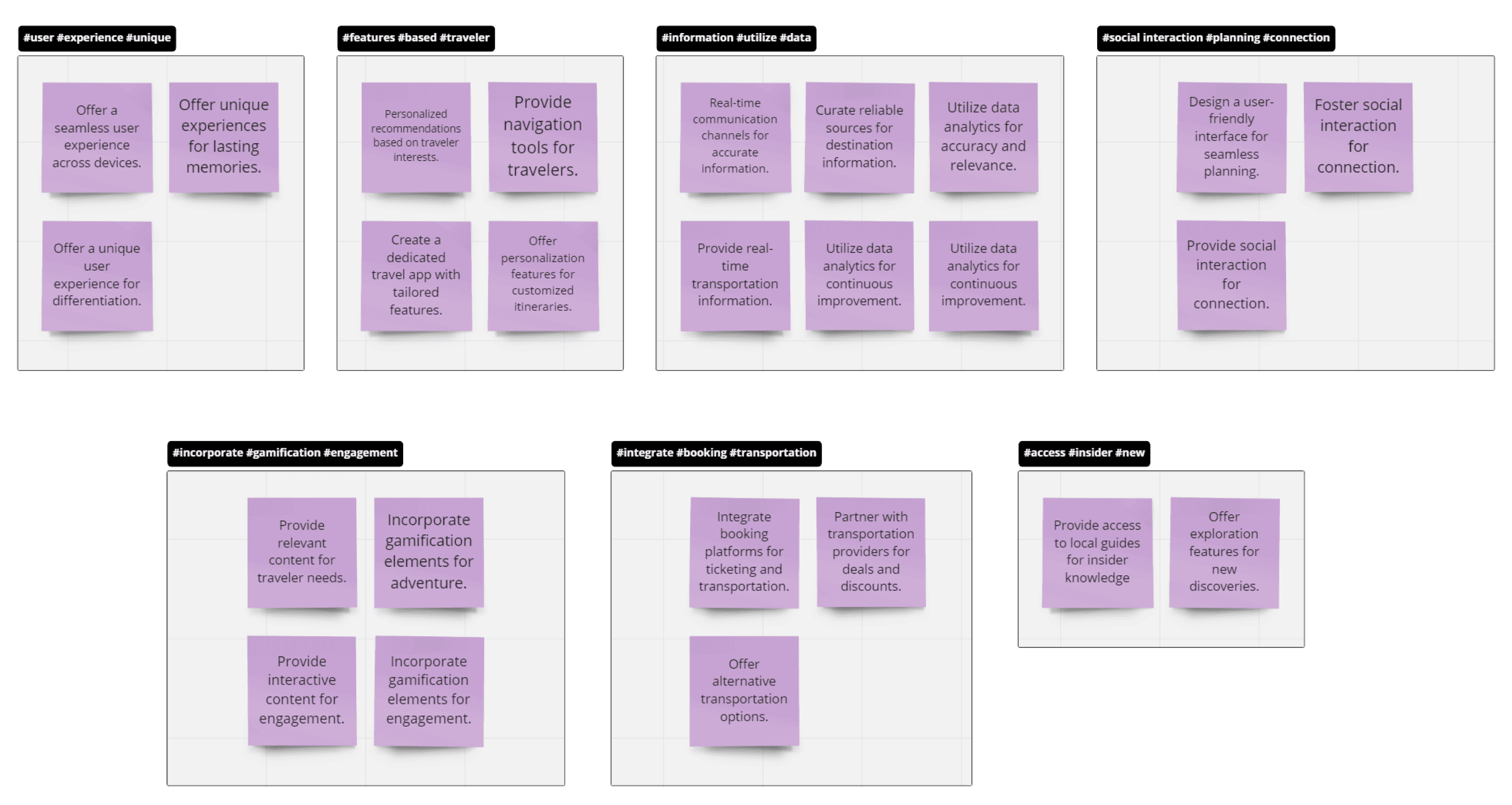
We identified 5 key areas and formulated the most relevant HMWs that will guide us. Based on this, we created a main How Might We question that encompasses all the key aspects to help us in the ideation process.
How might we provide travelers with timely and accurate information about their destination to enhance their overall travel experience?
How might we create an integrated platform that allows travelers to easily purchase tickets and access various transportation options?
How might we design a travel app that is tailored to the unique needs and preferences of travelers?
How might we provide travelers with a sense of discovery and adventure through the app's features and functionalities?
How might we incorporate personalization and gamification features that incentivize and engage travelers to explore and try new things?
?
How might we design a social companion app that help travelers discover new places, connect with others, and have fun in new cities?
02
Ideate
Story Board
To help visualize the user's experience and identify critical points where additional support or guidance may be needed while using the app, a storyboard was created.

Wireframes/sketches
I created a few lo-fi wireframes of the basic layout of the app and the different features that would be in it.
Through the wireframes, it helped us:
Identify the specific features and functionality that would best address the needs of travelers and explorers in discovering new places, connecting with others, and having fun in new cities.
Determine the optimal user flow and navigation for the app, ensuring that users can easily access the features and information they need to have a positive exploration experience.
Create low-fidelity prototypes to test and iterate on different design solutions, honing in on the most effective and intuitive design.
Experiment with different branding and visual design options, creating a consistent and engaging visual identity for the app that aligns with the needs and preferences of your target users.
03
Design
Hi-Fi Prototypes
We incorporated feedback from the team throughout the design process by presenting wireframes and hi-fi prototypes and gathering feedback through design critiques. Based on the feedback, we made changes and iterations to our designs to ensure they aligned with user needs and expectations.
04
Test
User Testing
To test the effectiveness of the social companion app we designed for travelers, we conducted usability testing with a group of 10 participants who were interested in exploring new cities. The testing was conducted in-person and through a post questionnaire through survey-monkey, and the participants were asked to complete a series of tasks related to discovering new places, connecting with other travelers, and having fun in new cities.

Results
During the user testing process, we gathered feedback from 10 participants with varying needs, attitudes towards technology, and familiarity with exploring new cities. Overall, users found the app to be intuitive and easy to use, and appreciated the location-based notifications feature for providing real-time information about nearby attractions and activities. The Connect feature was also found to be useful for meeting other travelers and making new friends.
However, some users encountered issues with the Tap to collect feature, which did not always provide accurate or timely information about nearby attractions and activities. Additionally, users suggested adding more personalization features to the app, such as the ability to customize notifications and filter search results based on their interests.
Based on this feedback, we were able to identify pain points and areas for improvement in our design. We made changes and iterations to our designs to improve the user experience and ensure that our final design met the needs and expectations of our users. We conducted in-person user testing as well as a survey questionnaire through Survey Monkey to gather feedback on the experience of using our Hi-Fi prototype.
Design iterations
The feedback we received from our user testing sessions helped us identify areas for improvement and make design decisions to enhance the user experience of our social companion app for travelers. Here are the main areas of feedback we received:
Location-based notifications: Testers appreciated the real-time information about nearby attractions and activities provided by the location-based notifications feature
Connect feature: Testers found the Connect feature useful for meeting other travelers and making new friends based on shared interests and preferences.
Tap to collect feature: Some testers noted possible issues with the accuracy and timeliness of the information provided by the Tap to collect feature.
Personalization features: Testers suggested adding more personalization features to the app, such as the ability to customize notifications and filter search results based on their interests.
Incorporating feedback from user testing allowed us to identify pain points and areas for improvement in our app design. By addressing these issues, we were able to create a final design that is more intuitive, streamlined, and personalized for the needs of our target users. We made changes and iterations to our design, including improving the accuracy and timeliness of the Tap to collect feature and adding more personalization features to the app to enhance the user experience.
Future Steps
Integration with Social Media Platforms: One way to increase the engagement and reach of our app is to integrate it with popular social media platforms such as Facebook, Instagram, and Twitter. This will allow users to easily share their experiences and connect with other travelers, potentially increasing the user base and exposure of our app.
Implementing Machine Learning and AI: To further personalize the recommendations and notifications provided by our app, we can explore the use of machine learning algorithms. By analyzing user data and behavior, we can make more accurate and relevant recommendations to users, improving their overall experience with the app.
Expanding to More Cities: Currently, the app is focused only for Toronto. As a future step, we can expand the coverage to more cities, both domestically and internationally, to provide a wider range of travel options to our users. We can conduct market research to identify popular travel destinations and prioritize the expansion accordingly.
Incorporating User Reviews and Ratings: User reviews and ratings are crucial for our app's functionality and user engagement. As a future step, we can incorporate user reviews and ratings for places and activities into our app, allowing users to easily access and contribute to the knowledge base of the app. This will also require us to implement features such as filters and sorting functions for reviews.
Enhancing Security and Privacy: As our app deals with sensitive user data such as location and payment information, it is important to prioritize security and privacy. As a future step, we can explore options such as two-factor authentication, encryption, and data anonymization to enhance the security and privacy of our app. We can also conduct user testing to ensure that users are comfortable with the level of privacy and security provided by the app.
I design intuitive, data-informed digital tools that solve complex problems — with a focus on clarity, usability, and business impact.
Improving City Exploration Through NFC
Educational city exploration
Educational city exploration
We aimed to make travelling and exploring new cities more enjoyable for users.
We aimed to make travelling and exploring new cities more enjoyable for users.
Client
George Brown College
Services
UI & UX Design
Project management
Visual Design
User Research
Prototyping
Competitive Research
Concept ideation
Industries
Travel
Date
September 2021
Problem
People who want to explore new cities often lack the guidance and support they need to make the most of their trip. They have difficulty finding relevant information about the places they visit, and they miss out on opportunities to connect with other travelers and locals. Many of them feel bored and frustrated by the lack of engagement and interaction in their travel experience.
What are the needs of explorers when they travel to new cities?
Explorers and travelers want to break free from their routine and broaden their horizons by having new experiences. They seek reliable and relevant information to help them navigate the places they visit. They also want to connect with people who share their interests and engage with the local culture and environment.
Experiences
Reliable Info
Connection
Engagement
What is wrong with the existing solutions?
Explorers and travelers want to break free from their routine and broaden their horizons by having new experiences. They seek reliable and relevant information to help them navigate the places they visit. They also want to connect with people who share their interests and engage with the local culture and environment.
Not providing timely or accurate information
Not offer a way to purchase tickets or access transportation options
Rely on existing platforms that are not tailored to travelers’ needs
Not create a sense of discovery or adventure
Lack personalization or gamification features
Google Maps
Meetup
City Mapper
Trip Advisor
As a result...
“I’m not sure where to find other
travelers like me”
“I wish I could purchase tickets
without going to so many websites”
“I don’t feel motivated to explore
this city I’m in”
“I want travelling to be less
overwhelming but easier”
“I wish the locals could tell me
what the best restaraunt in town is”
?
How might we design a social companion app that help travelers discover new places, connect with others, and have fun in new cities?
The Solution
We designed a social companion app that helps explorers and travelers discover new places in the cities they visit. The app allows users to tap their phone’s NFC chip on specific bus stops and get relevant and timely information about the nearby attractions, activities, and events. Users can also purchase tickets for transportation and entertainment through the app, and connect with other explorers who share their interests and preferences. The app enhances the exploration experience by offering a gallery of pictures of places visited by other explorers, and by gamifying the exploration process with rewards and challenges.
My Role
UX/UI Designer
Team Members
Manan Monga, Jackson Howlette
Tools
Figma, Sketchup, Adobe XD, Miro, Photoshop, Illustrator
Location-Based Notifications
Get real-time information and tickets for attractions and points of interest with Alerts
Alerts that show up on your phone when you are near a point of interest or attraction. They help you learn more about the place, find other explorers, and tap your phone’s NFC chip on bus stops for information and tickets. They make your exploration experience more engaging, interactive, and fun.
Discover with other explorers
Explore your city with like-minded people and make new friends with the Connect feature
Connect with other users of the app in the same city as you. You can chat with them, share tips and recommendations, ask questions, and see what they have discovered. You can also find other explorers who have similar interests and preferences as you, and join them for an adventure. This feature helps you make new friends, learn from others, and have more fun in your exploration.
Explorer’s Gallery
Discover the hidden gems of your city and share your own with the community using Explorer’s Gallery
Explorer’s Gallery is a feature that lets you see pictures of places visited by other explorers using the app. You can browse through the gallery and get inspired by the beautiful and interesting sights that others have seen. You can also upload your own pictures and share your discoveries with the community. Explorer’s Gallery is a feature that helps you appreciate the diversity and beauty of the cities you explore.
Tap to collect
Discover new places and collect achievements with the Tap to collect feature
This feature allows you to get relevant and timely information about nearby attractions, activities, and events by simply tapping your phone’s NFC chip on specific bus stops. This feature is designed to enhance and gamify your exploration experience by providing you with the most up-to-date information about the places you visit while collecting achievements.
Our Approach
01
Research
Competitive Analysis
User Research
User Personas
Problem statement
02
Ideate
Informed Brainstorming
Sketching Exercises
Lo-fi wireframes/sketches
03
Design
Hi-fi Interactive prototypes
Features implementation
User feedback
Design iterations
04
Test
User Testing
Design Presentation
Design iterations
My contribution
My teammate and I worked collaboratively on this project as part of a design course in 2020. We both contributed equally to the project, including tasks such as prototype and photoshop designs, creating presentation materials, and participating in the ideation process. Our roles and responsibilities were shared equally, with both of us contributing to the various tasks and activities required to complete the project.
My role as a UX/UI Designer on this project was to advocate for user research, competitive analysis, ideation and design. I collaborated with my team mate Jackson to conduct research and design activities, and to produce wireframes, high fidelity designs and interactive prototypes for user feedback and testing.
I applied a user-centered design process to project. This involved: analyzing competitors; defining and aligning on the main problem; and generating and evaluating ideas using sketching, wireframing, prototyping, and feedback sessions.
01
Research
Competitive Analysis
Our first step was to analyze the existing solutions from our competitors and see if we could learn from their design choices.


We found that:
Most competitors do not focus on social features that allow travelers to connect with locals or other travelers. Airbnb does offer and “experiences” feature that allows travelers to book activities and tours led by local hosts.
Most competitors do not offer features that encourage travelers to explore new places or take risks. However, Google maps offers exploration features, such as the ability to search for nearby restaurants, attractions, and activities.
Competitors do not offer enough personalization features that cater to the unique preferences and interests of individual travelers
Pokémon Go and Geocaching incorporate features that encourage travelers to explore new places, complete challenges, or earn rewards for their activities.
Therefore, our goal is to create a unique travel app that combines social, exploration, personalization, and gamification features to offer a more immersive and personalized travel experience.
User Personas
To better guide our design and enable everyone on the team to empathize with our users, I came up with the following personas using our research:
Mind Map and Brainstorming
To understand what users struggle with in existing travel apps and identify solutions, I advocated for researching and mapping user needs and potential features before diving into solutions. I also invited the team to brainstorm together for better ideas based on our findings.

We identified 5 key areas and formulated the most relevant potential features that will guide us.


Based on this, we grouped all our ideas by keywords to help us in the ideation process. This approach allowed us to identify commonalities and patterns among the ideas and helped us to develop more focused and effective solutions

We identified 5 key areas and formulated the most relevant HMWs that will guide us. Based on this, we created a main How Might We question that encompasses all the key aspects to help us in the ideation process.
How might we provide travelers with timely and accurate information about their destination to enhance their overall travel experience?
How might we create an integrated platform that allows travelers to easily purchase tickets and access various transportation options?
How might we design a travel app that is tailored to the unique needs and preferences of travelers?
How might we provide travelers with a sense of discovery and adventure through the app's features and functionalities?
How might we incorporate personalization and gamification features that incentivize and engage travelers to explore and try new things?
?
How might we design a social companion app that help travelers discover new places, connect with others, and have fun in new cities?
02
Ideate
Story Board
To help visualize the user's experience and identify critical points where additional support or guidance may be needed while using the app, a storyboard was created.

Wireframes/sketches
I created a few lo-fi wireframes of the basic layout of the app and the different features that would be in it.
Through the wireframes, it helped us:
Identify the specific features and functionality that would best address the needs of travelers and explorers in discovering new places, connecting with others, and having fun in new cities.
Determine the optimal user flow and navigation for the app, ensuring that users can easily access the features and information they need to have a positive exploration experience.
Create low-fidelity prototypes to test and iterate on different design solutions, honing in on the most effective and intuitive design.
Experiment with different branding and visual design options, creating a consistent and engaging visual identity for the app that aligns with the needs and preferences of your target users.
03
Design
Hi-Fi Prototypes
We incorporated feedback from the team throughout the design process by presenting wireframes and hi-fi prototypes and gathering feedback through design critiques. Based on the feedback, we made changes and iterations to our designs to ensure they aligned with user needs and expectations.
04
Test
User Testing
To test the effectiveness of the social companion app we designed for travelers, we conducted usability testing with a group of 10 participants who were interested in exploring new cities. The testing was conducted in-person and through a post questionnaire through survey-monkey, and the participants were asked to complete a series of tasks related to discovering new places, connecting with other travelers, and having fun in new cities.

Results
During the user testing process, we gathered feedback from 10 participants with varying needs, attitudes towards technology, and familiarity with exploring new cities. Overall, users found the app to be intuitive and easy to use, and appreciated the location-based notifications feature for providing real-time information about nearby attractions and activities. The Connect feature was also found to be useful for meeting other travelers and making new friends.
However, some users encountered issues with the Tap to collect feature, which did not always provide accurate or timely information about nearby attractions and activities. Additionally, users suggested adding more personalization features to the app, such as the ability to customize notifications and filter search results based on their interests.
Based on this feedback, we were able to identify pain points and areas for improvement in our design. We made changes and iterations to our designs to improve the user experience and ensure that our final design met the needs and expectations of our users. We conducted in-person user testing as well as a survey questionnaire through Survey Monkey to gather feedback on the experience of using our Hi-Fi prototype.
Design iterations
The feedback we received from our user testing sessions helped us identify areas for improvement and make design decisions to enhance the user experience of our social companion app for travelers. Here are the main areas of feedback we received:
Location-based notifications: Testers appreciated the real-time information about nearby attractions and activities provided by the location-based notifications feature
Connect feature: Testers found the Connect feature useful for meeting other travelers and making new friends based on shared interests and preferences.
Tap to collect feature: Some testers noted possible issues with the accuracy and timeliness of the information provided by the Tap to collect feature.
Personalization features: Testers suggested adding more personalization features to the app, such as the ability to customize notifications and filter search results based on their interests.
Incorporating feedback from user testing allowed us to identify pain points and areas for improvement in our app design. By addressing these issues, we were able to create a final design that is more intuitive, streamlined, and personalized for the needs of our target users. We made changes and iterations to our design, including improving the accuracy and timeliness of the Tap to collect feature and adding more personalization features to the app to enhance the user experience.
Future Steps
Integration with Social Media Platforms: One way to increase the engagement and reach of our app is to integrate it with popular social media platforms such as Facebook, Instagram, and Twitter. This will allow users to easily share their experiences and connect with other travelers, potentially increasing the user base and exposure of our app.
Implementing Machine Learning and AI: To further personalize the recommendations and notifications provided by our app, we can explore the use of machine learning algorithms. By analyzing user data and behavior, we can make more accurate and relevant recommendations to users, improving their overall experience with the app.
Expanding to More Cities: Currently, the app is focused only for Toronto. As a future step, we can expand the coverage to more cities, both domestically and internationally, to provide a wider range of travel options to our users. We can conduct market research to identify popular travel destinations and prioritize the expansion accordingly.
Incorporating User Reviews and Ratings: User reviews and ratings are crucial for our app's functionality and user engagement. As a future step, we can incorporate user reviews and ratings for places and activities into our app, allowing users to easily access and contribute to the knowledge base of the app. This will also require us to implement features such as filters and sorting functions for reviews.
Enhancing Security and Privacy: As our app deals with sensitive user data such as location and payment information, it is important to prioritize security and privacy. As a future step, we can explore options such as two-factor authentication, encryption, and data anonymization to enhance the security and privacy of our app. We can also conduct user testing to ensure that users are comfortable with the level of privacy and security provided by the app.