Designing an AI-Powered Tool to Validate Business Ideas
Helping early-stage entrepreneurs make smarter, location-informed decisions
Client
Smart Start
Services
UI & UX Design
Project management
Visual Design
User Research
Prototyping
Competitive Research
Concept ideation
Industries
Technology (AI/Business Support)
Date
June 2023

Problem
New entrepreneurs struggle to evaluate the potential success of their business ideas based on their location and situation. They need easy-to-use, all-inclusive tools to help them confidently decide whether to invest in their ideas.
What difficulties do new entrepreneurs face when figuring out if their ideas will work?
New entrepreneurs aim to successfully launch their businesses by understanding their target market and location-specific factors. They require accessible and reliable tools to evaluate their ideas, as well as guidance to make informed decisions and navigate the complexities of their chosen industry.
Limited experience and knowledge
Market research
Location-specific factors
Access to resources
What is wrong with the existing solutions?
Explorers and travelers want to break free from their routine and broaden their horizons by having new experiences. They seek reliable and relevant information to help them navigate the places they visit. They also want to connect with people who share their interests and engage with the local culture and environment.
Bplans
Enloop
Live Plan
Upmetrics
Statista





As a result...
"I'm unsure how to factor in location when assessing my business idea."
"I can't find a tool that really caters to my unique business idea and situation."
"I wish there were simpler tools to evaluate my idea."
“I wish I had more guidance and support for my particular idea."
“It's hard to find affordable resources to help me figure out if my business idea will work."
?
How can we develop a user-friendly app to help entrepreneurs assess their business ideas with personalized guidance?
The Solution
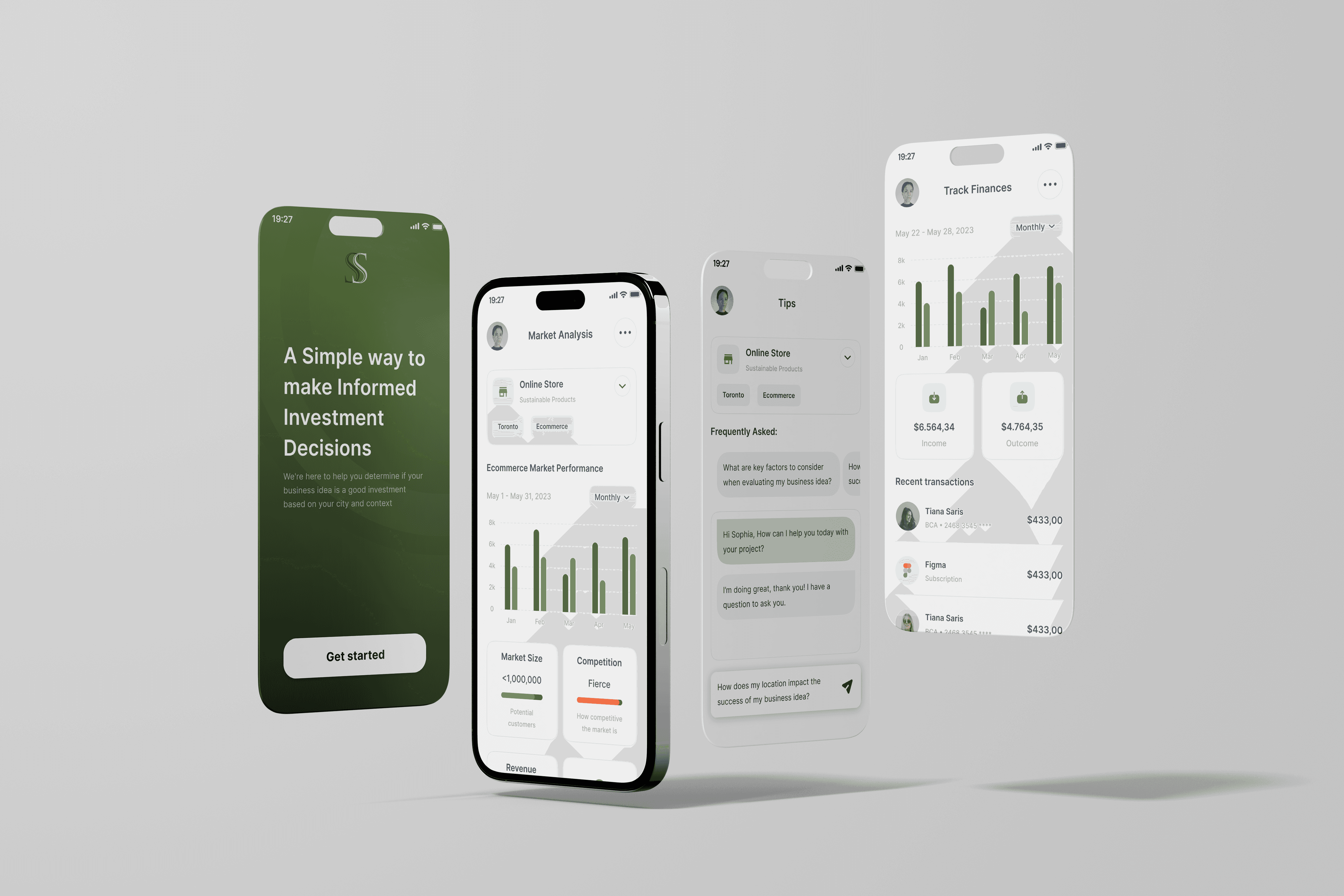
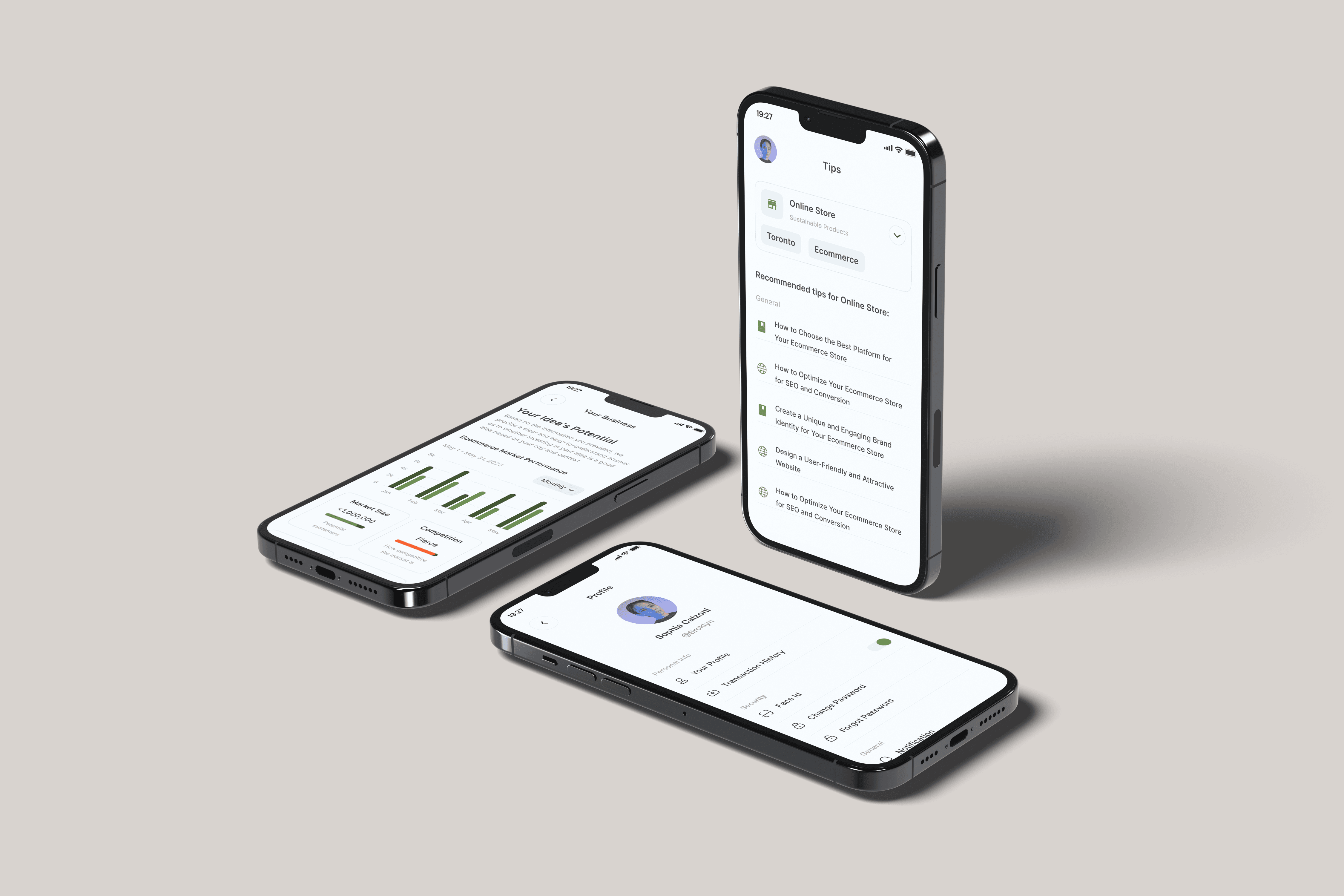
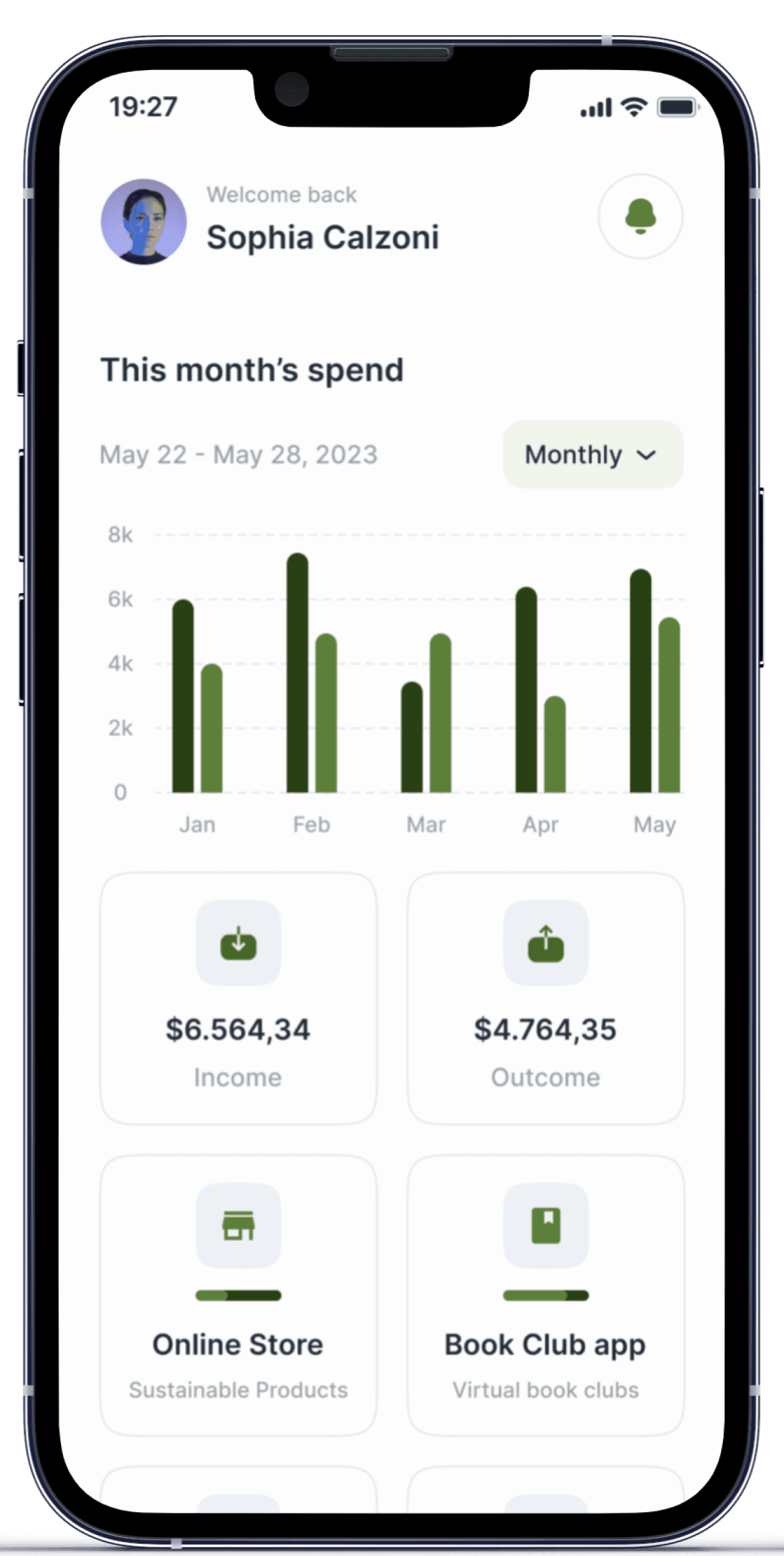
Introducing Smart Start, an AI-powered mobile app, utilizing GPT-4, to help new entrepreneurs evaluate their business ideas based on their city and context. The app provides tailored guidance and insights, personalized to each user's idea during the onboarding process. Featuring a user-friendly interface, Smart Start includes a home button, a budget tracker, a market button for general market analysis and industry data, and a chat/tips button for AI-generated recommendations based on the business type.
GPT-4 simulates conversations with experienced mentors, offering real-time advice and answers to common questions about business planning and evaluation processes. Users can access frequently updated market reports and industry data within the app while also utilizing trusted external resources for market data and financial forecasts. GPT-4 helps interpret and apply this information to the user's unique business idea, streamlining decision-making and empowering entrepreneurs to make informed investments in their ventures.
My Role
UX/UI Designer
Team Members
Manan Monga
Tools
Figma, FigJam, Miro, Photoshop, Illustrator
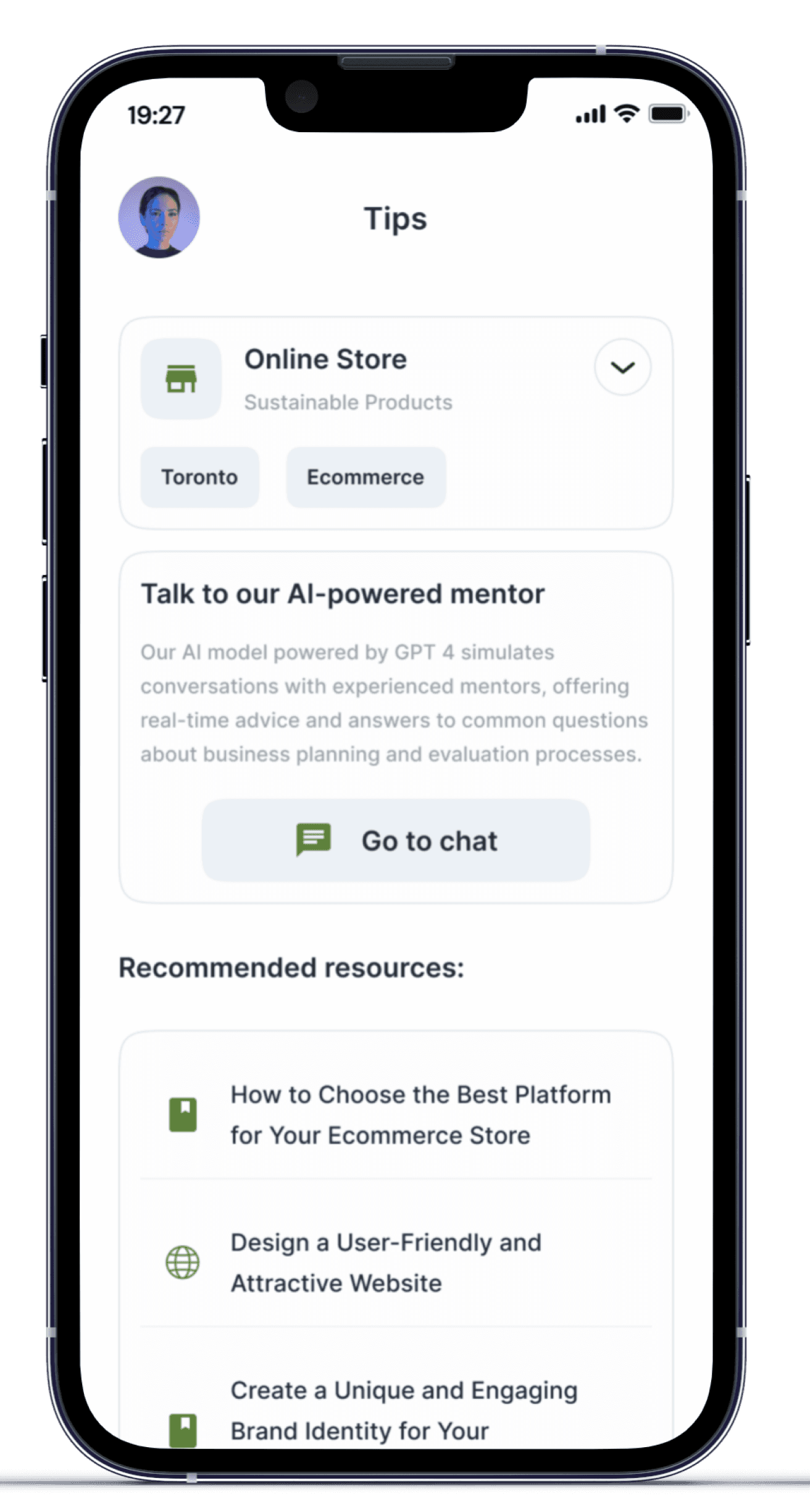
AI- Powered Mentorship
Receive personalized guidance and insights with the AI-Powered Mentorship feature
Our app's AI-Powered Mentorship simulates conversations with experienced mentors, offering real-time advice and answers to common questions about business planning and evaluation processes. This feature allows users to benefit from expert knowledge and insights tailored to their unique business idea, helping them make informed decisions and navigate the entrepreneurial journey with confidence.
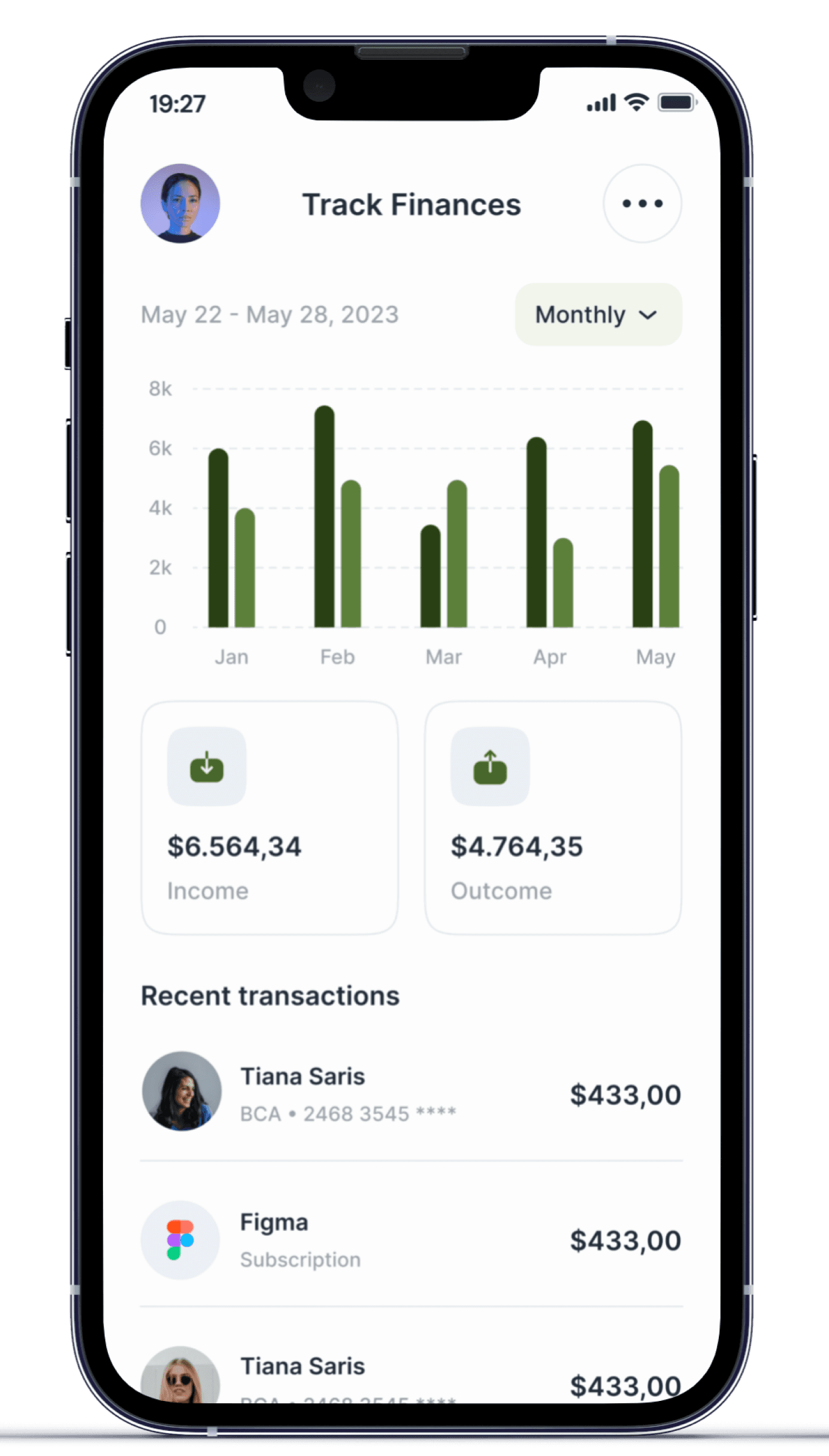
Budget Tracker
Monitor and manage expenses with the Budget Tracker feature
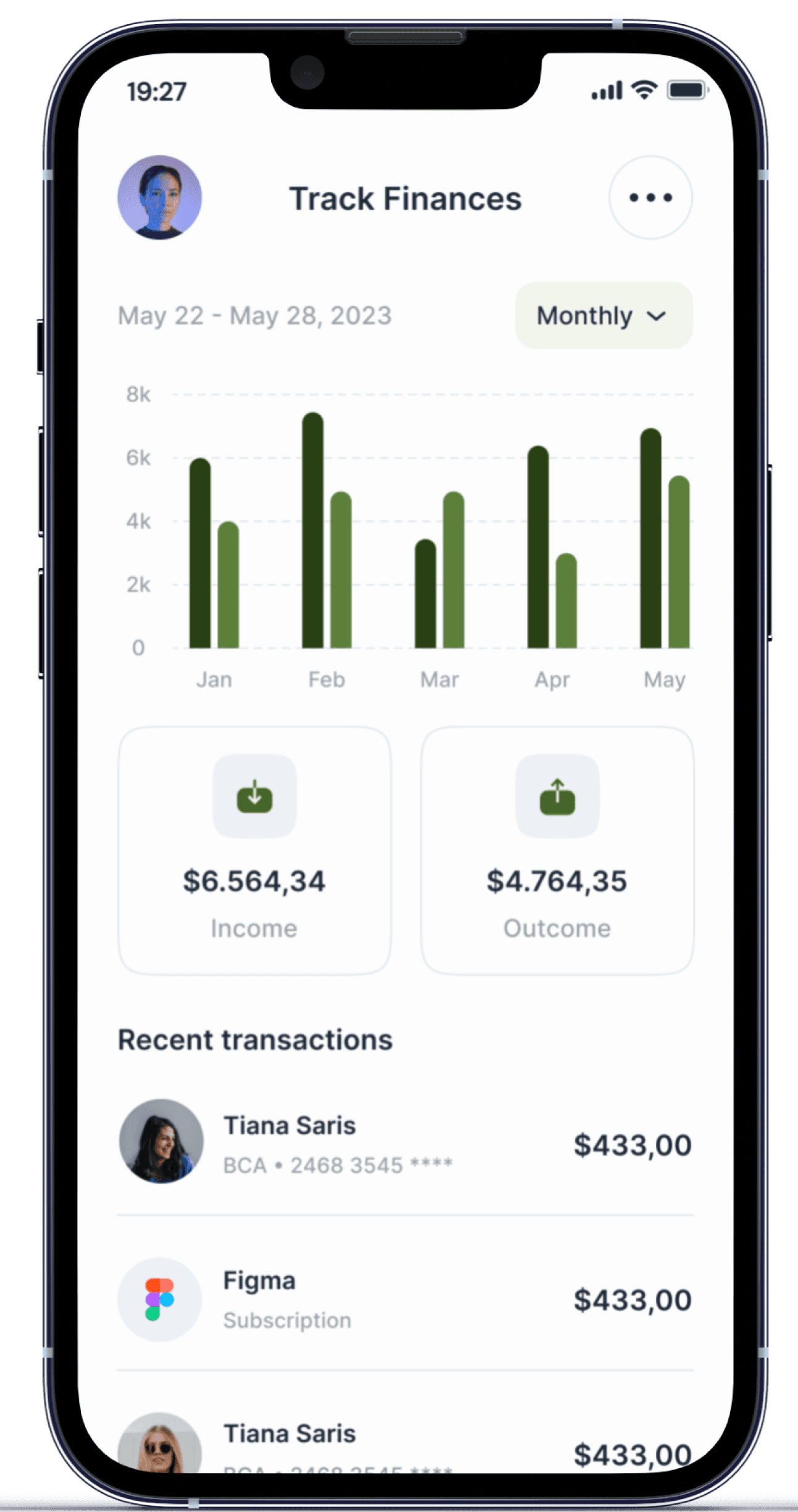
The Budget Tracker helps users keep track of their spending and manage their finances efficiently. Users can input expenses, set spending limits, and monitor their financial performance over time. This feature helps entrepreneurs maintain financial discipline and make informed decisions about their budget allocations.
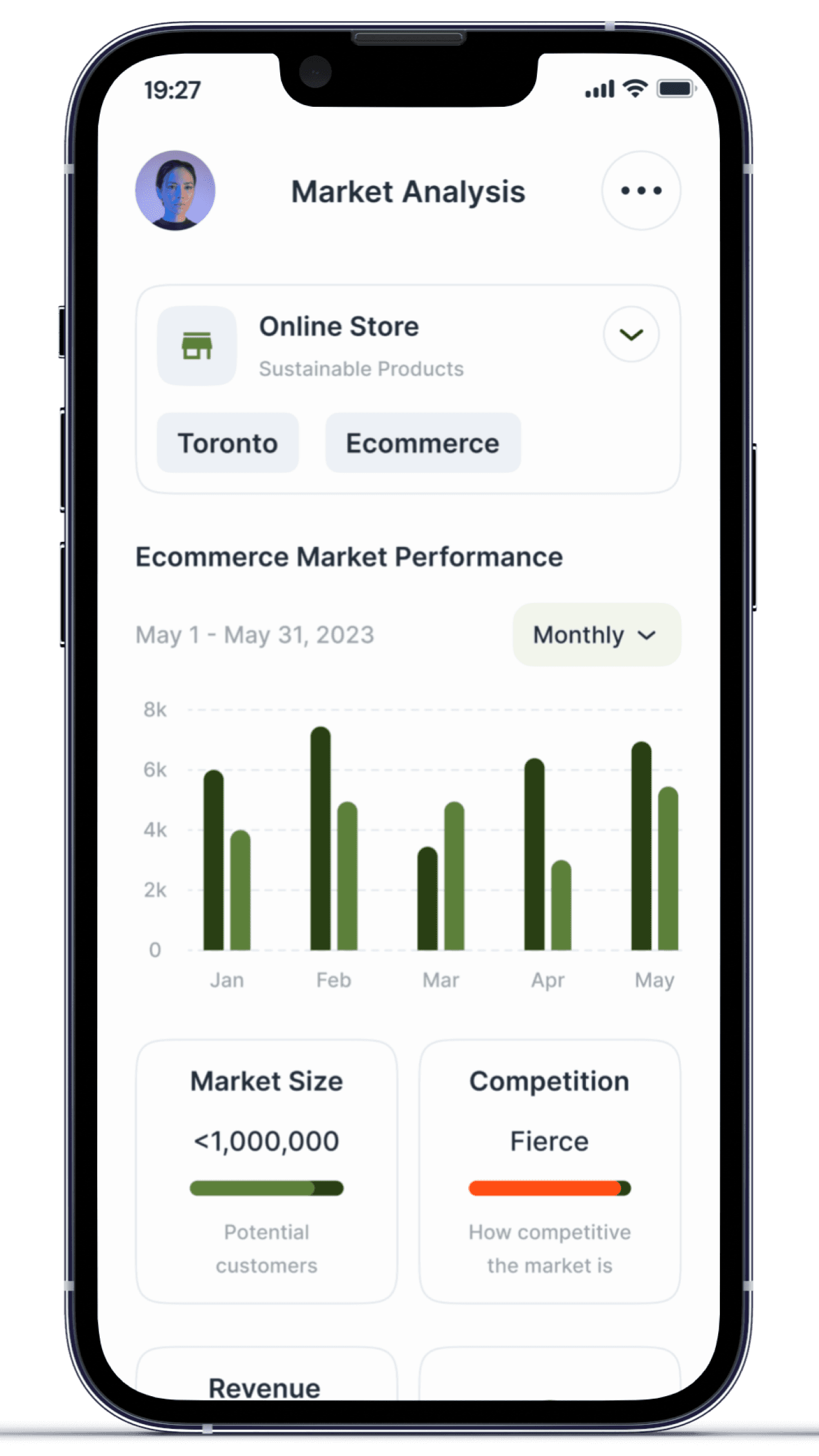
Market Intelligence
Access up-to-date market analysis and industry data with the Market Intelligence feature
The Market Intelligence button gives users access to general market analysis, industry data, and frequently updated market reports. This feature helps entrepreneurs stay informed about market trends, competitors, and opportunities, allowing them to make strategic decisions based on current data.
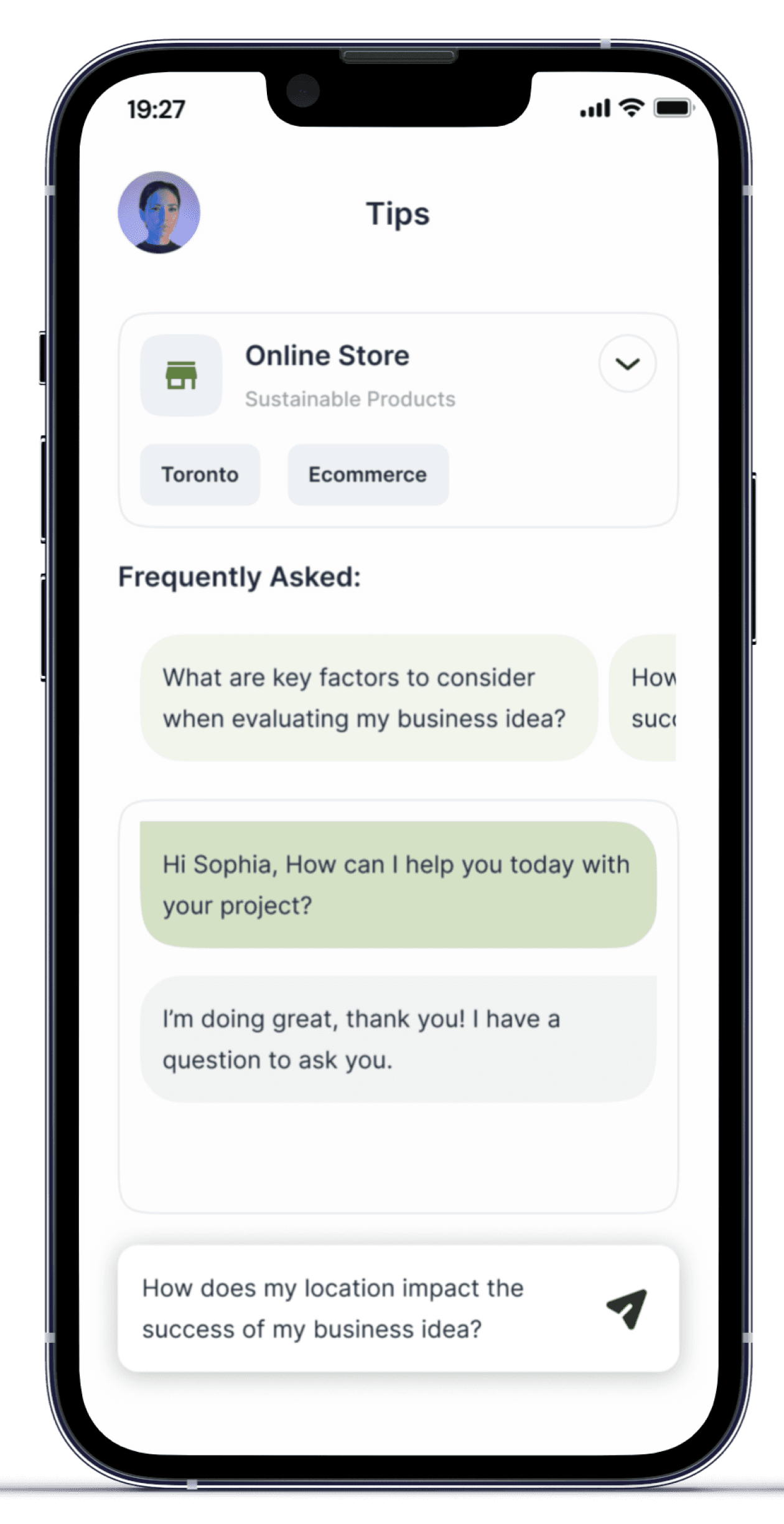
Chat & Tips
Get personalized recommendations and advice using the Chat & Tips feature
The Chat & Tips button provides AI-generated personalized recommendations based on the user's industry and type of business. By leveraging GPT-4's capabilities, users can get real-time advice and suggestions to help them refine their business strategy, identify potential pitfalls, and enhance their venture's chances of success.
My Approach
01
Research
Competitive Analysis
User Research
User Personas
Problem statement
02
Ideate
Informed Brainstorming
Sketching Exercises
Lo-fi wireframes/sketches
03
Design
Hi-fi Interactive prototypes
Features implementation
User feedback
Design iterations
04
Test
User Testing
Design Presentation
Design iterations
My contribution
In this personal project, I took on the role of a UX/UI Designer, independently managing all aspects from start to finish. I was solely responsible for all tasks, including prototype and Photoshop designs, creating presentation materials, and participating in the ideation process.
As a UX/UI Designer, my role involved advocating for user research, competitive analysis, ideation, and design. I conducted research and design activities on my own, creating wireframes, high fidelity designs, and interactive prototypes for user feedback and testing.
Throughout the project, I employed a user-centered design process. This involved: analyzing competitors; defining and aligning on the main problem; and generating and evaluating ideas using sketching, wireframing, prototyping, and feedback sessions. By completing the entire project independently, I gained valuable experience in managing and executing all aspects of a UX/UI design project for my personal portfolio.
01
Research
Competitive Analysis
Our first step was to analyze the existing solutions from our competitors and see if we could learn from their design choices in the context of business idea evaluation tools.
We found that:
Therefore, our goal is to create a unique business idea evaluation app that combines personalized guidance, AI-driven insights, user-friendly design, and comprehensive features to offer a more effective and tailored experience for new entrepreneurs.
User Personas
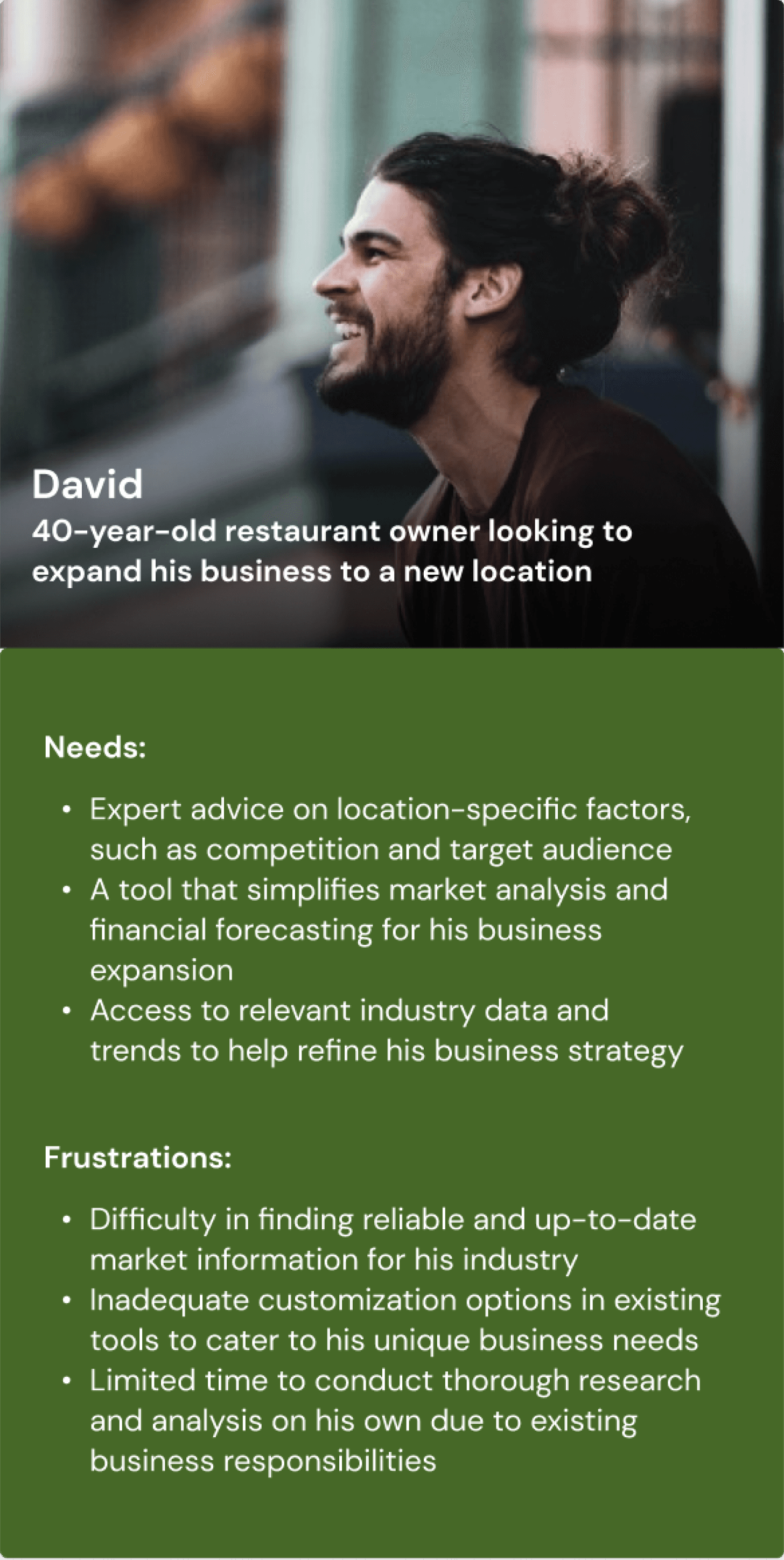
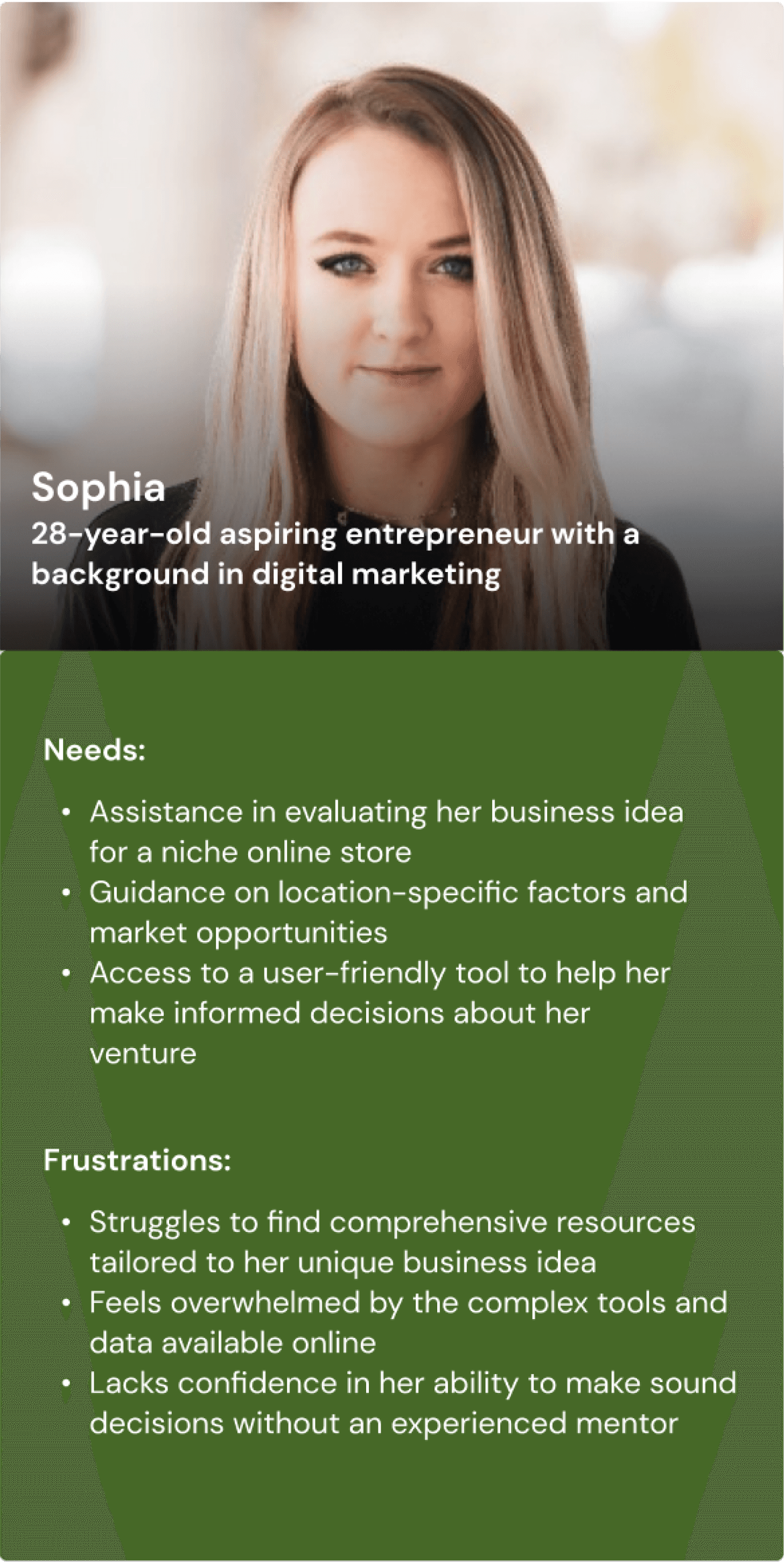
To better guide our design and enable everyone on the team to empathize with our users, we came up with the following personas using our research:
Mind Map and Brainstorming
To understand what users struggle with in existing travel apps and identify solutions, I advocated for researching and mapping user needs and potential features before diving into solutions. I also invited the team to brainstorm together for better ideas based on our findings.
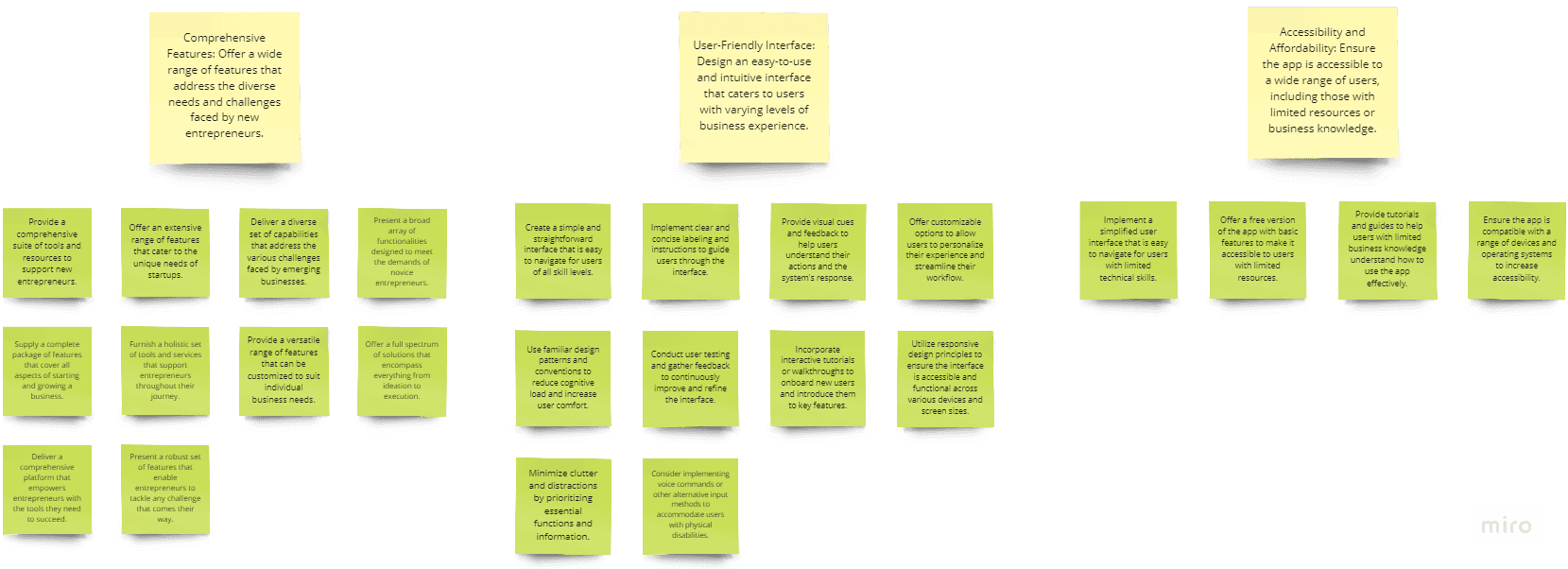
We identified 5 key areas and formulated the most relevant potential features that will guide us.

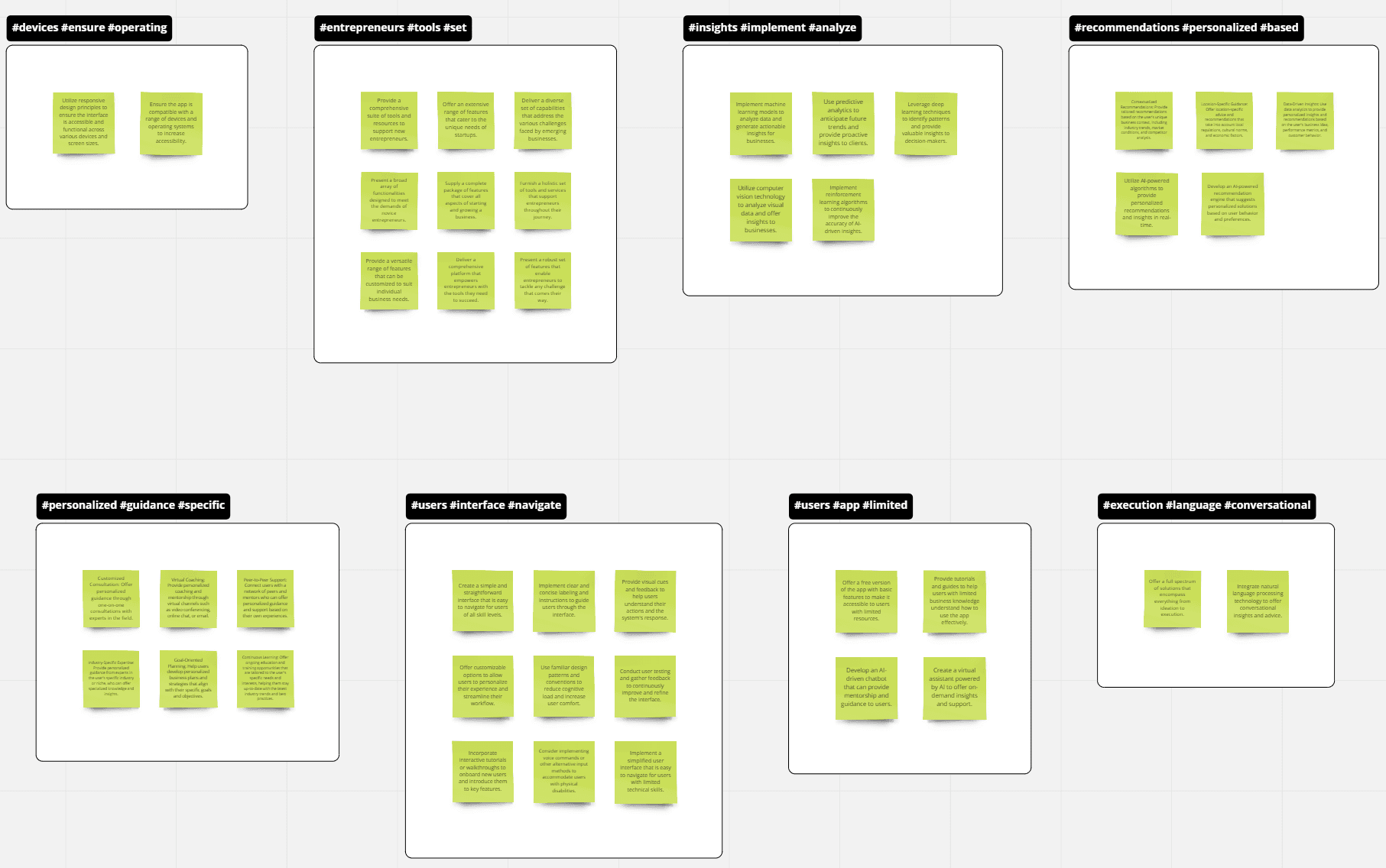
Based on this, we grouped all our ideas by keywords to help us in the ideation process. This approach allowed us to identify commonalities and patterns among the ideas and helped us to develop more focused and effective solutions
We identified 5 key areas and formulated the most relevant HMWs that will guide us. Based on this, we created a main How Might We question that encompasses all the key aspects to help us in the ideation process.
How might we create a personalized experience for entrepreneurs that offers tailored guidance and recommendations based on their unique business idea and situation?
How might we develop a user-friendly and easily accessible tool that simplifies the process of evaluating business ideas for entrepreneurs with varying levels of expertise?
How might we provide up-to-date and relevant market intelligence and industry data to help entrepreneurs make informed decisions based on their location and target market?
How might we integrate a budget tracking feature that empowers entrepreneurs to monitor and manage their expenses efficiently, promoting financial discipline and better decision-making?
How might we integrate a budget tracking feature that empowers entrepreneurs to monitor and manage their expenses efficiently, promoting financial discipline and better decision-making?
?
How might we create a user-friendly, AI-powered app offering personalized guidance, market intelligence, and financial management tools for new entrepreneurs to confidently evaluate and launch their business ideas tailored to their unique situation and location?
02
Ideate
User Flow Mindmap
To help visualize the user's experience and identify critical points where additional support or guidance may be needed while using the app, a mindmap was created.
Wireframes/sketches
I created a few lo-fi wireframes of the basic layout of the app and the different features that would be in it.
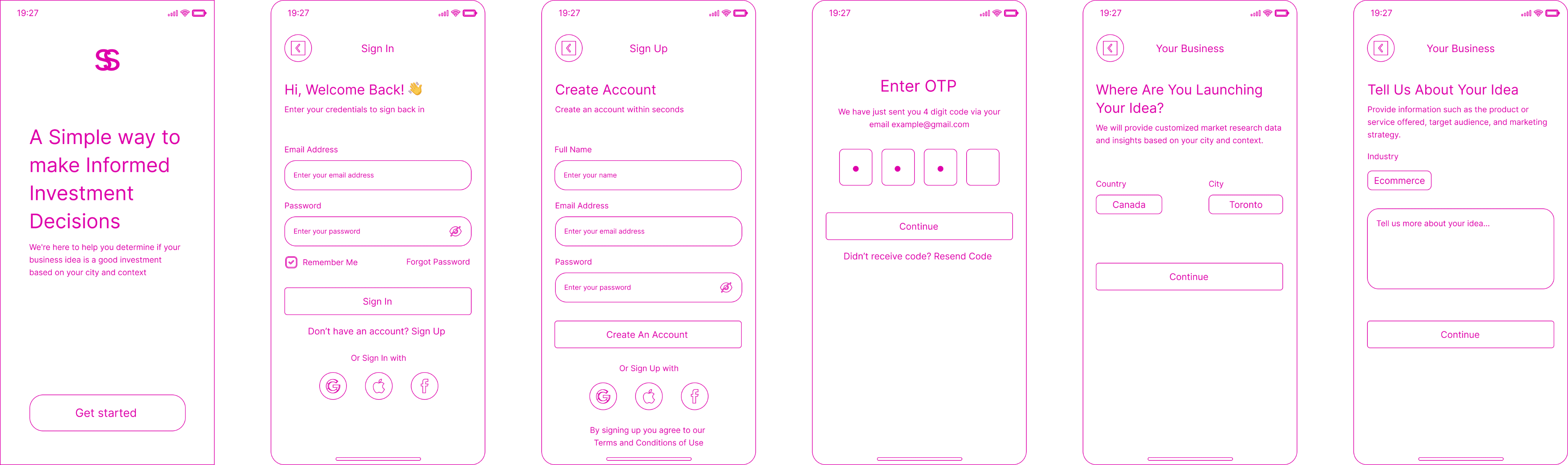
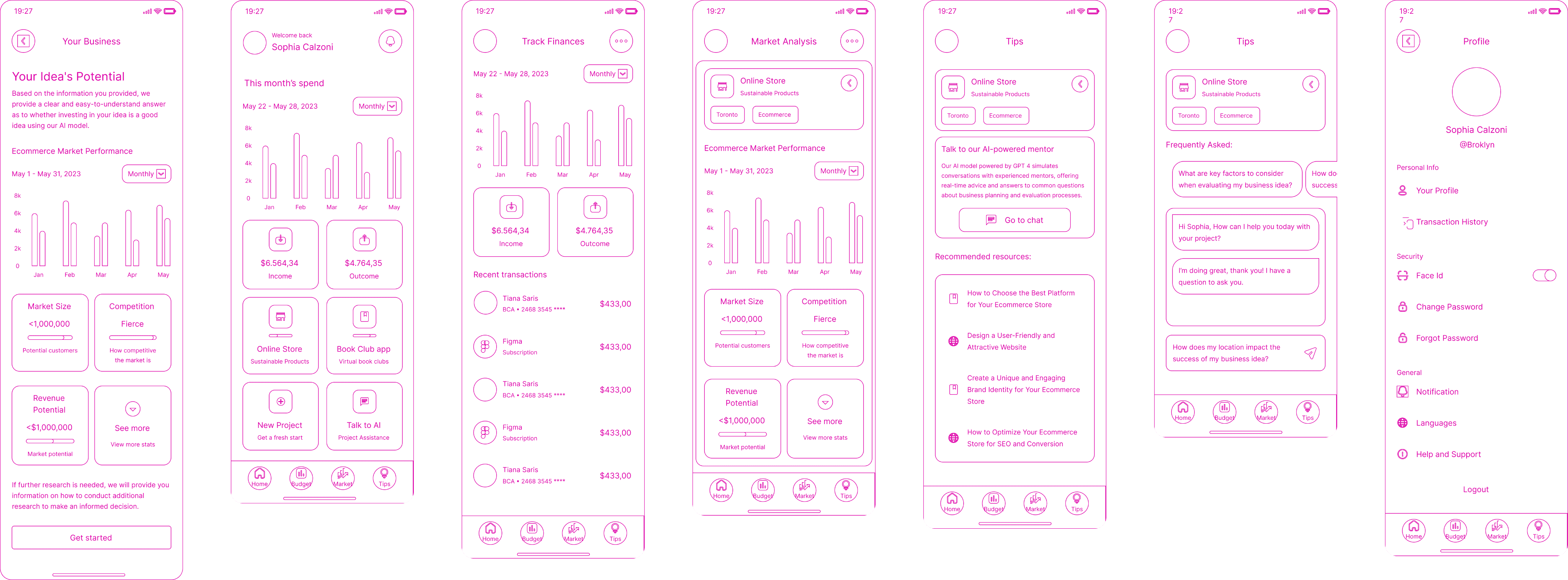
Through the wireframes, it helped me:
03
Design
Hi-Fi Prototypes
We incorporated feedback from the team throughout the design process by presenting wireframes and hi-fi prototypes and gathering feedback through design critiques. Based on the feedback, we made changes and iterations to our designs to ensure they aligned with user needs and expectations.


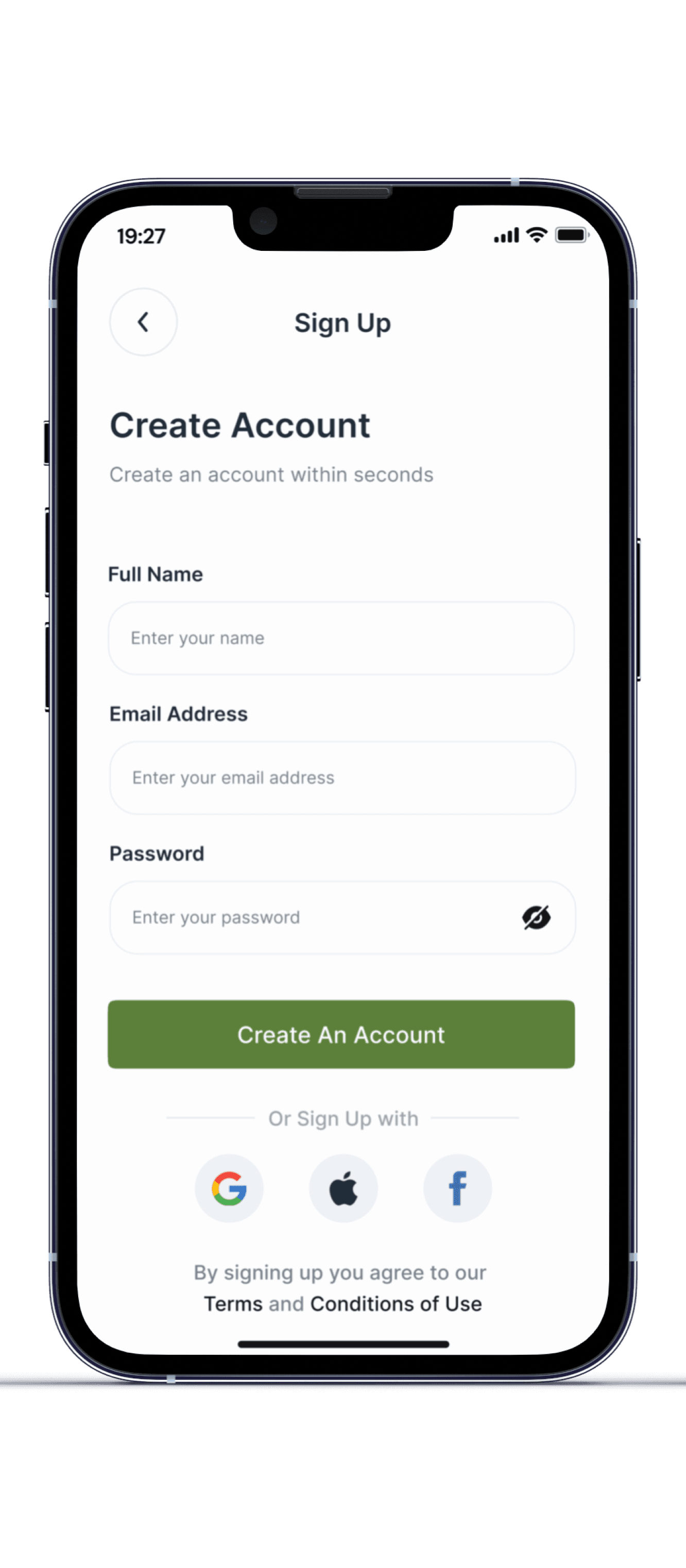
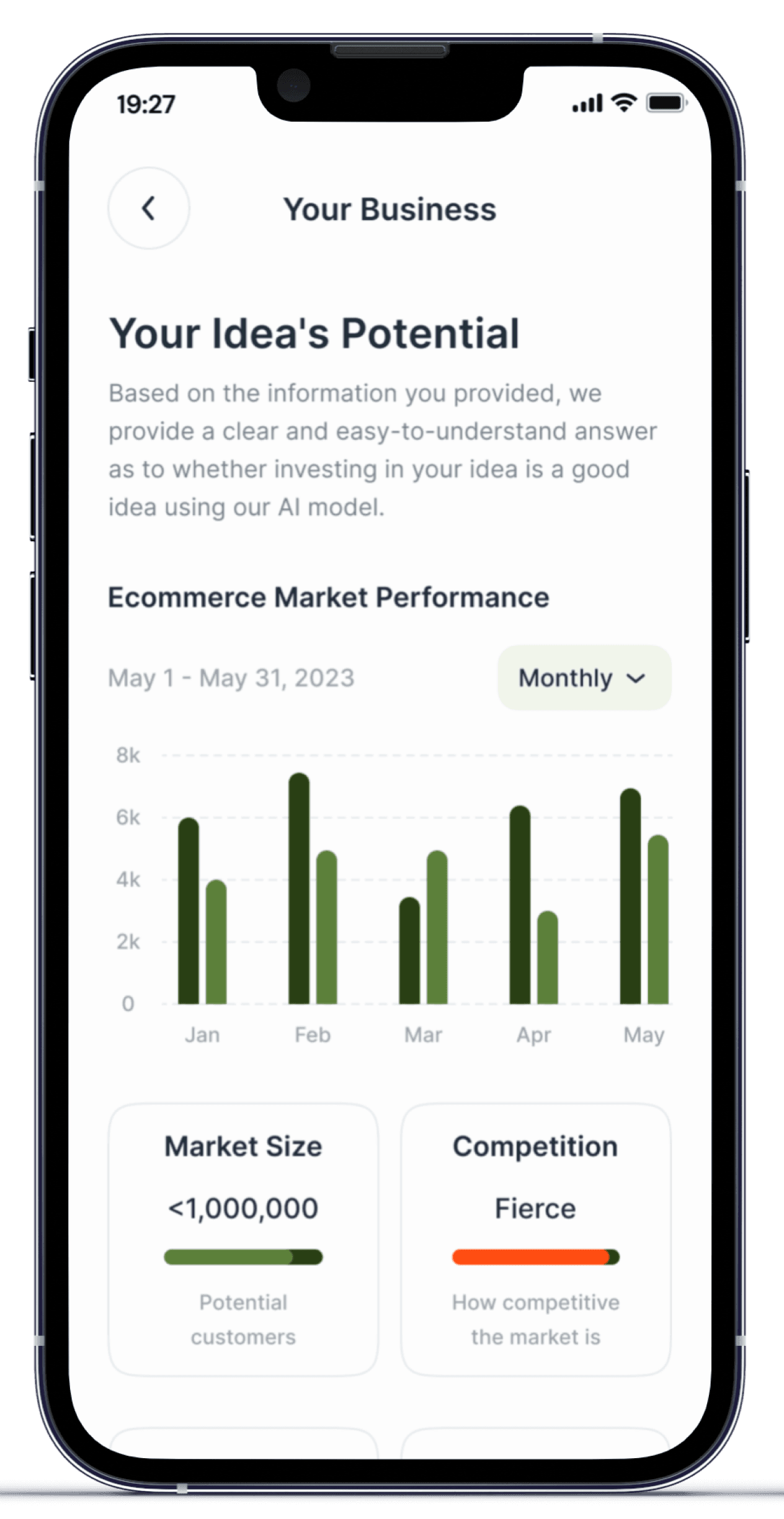

Interactive Prototype
The final prototype was designed on Figma with a responsive, mobile first approach.
04
Test
User Testing
To test the effectiveness of the Smart Start app we designed for aspiring entrepreneurs, we conducted usability testing with a group of 10 participants who were interested in starting their own businesses. The testing was conducted remotely, and the participants were asked to complete a series of tasks related to evaluating their business ideas, accessing market intelligence, and seeking guidance from an AI-powered mentor.
The participants were provided with a testing script and were asked to think aloud as they performed each task. After completing the tasks, they were asked to answer a post-task questionnaire through Survey Monkey to gather their feedback and insights.
Participant 1:
4 - The onboarding process was straightforward and easy to follow.
3 - The app provided some guidance, but I would have liked more specific insights tailored to my business idea.
4 - The Market Intelligence feature was helpful in providing industry data and market analysis.
4 - The AI-Powered Mentorship feature provided useful guidance, and I found the chatbot to be responsive.
One suggestion is to include case studies of successful businesses in similar industries to provide real-life examples.
Participant 2:
3 - The onboarding process was average in terms of intuitiveness and user-friendliness.
2 - The app lacked personalized guidance and insights, and I didn't feel supported in evaluating my business idea.
3 - The Market Intelligence feature had some relevant information, but I would have liked more detailed analysis.
3 - The AI-Powered Mentorship feature didn't address my specific questions adequately.
A suggestion is to incorporate interactive quizzes or assessments to help users evaluate their business ideas more effectively.
Participant 3:
5 - The onboarding process was intuitive and user-friendly.
4 - The app provided valuable guidance and insights that helped me evaluate my business idea effectively.
5 - The Market Intelligence feature was valuable in providing comprehensive industry data and market analysis.
5 - The AI-Powered Mentorship feature gave detailed and helpful answers to my questions.
No suggestions for improvement; overall, a great app experience.
Participant 4:
2 - The onboarding process was confusing, and I had difficulty understanding some of the steps.
1 - The app lacked personalized guidance and didn't provide enough insights for my specific business idea.
2 - The Market Intelligence feature had limited information and didn't provide in-depth analysis.
2 - The AI-Powered Mentorship feature didn't give satisfactory answers to my questions.
Suggestions: Improve the onboarding process with clearer instructions and provide more personalized recommendations throughout the app.
Participant 5:
4 - The onboarding process was easy to follow and understand.
5 - The app provided excellent guidance and insights tailored to my business idea.
4 - The Market Intelligence feature offered relevant industry data and market analysis that aided in my evaluation.
5 - The AI-Powered Mentorship feature gave me relevant advice and answered my questions effectively.
No suggestions for improvement; the app met my expectations.
Results
Onboarding Process Rating: 3.7 (Participants had mixed experiences with the onboarding process, with some finding it intuitive and others encountering confusion)
Effectiveness of Guidance and Insights: 3.4 (Participants desired more personalized and detailed guidance specific to their business ideas)
Value of Market Intelligence Feature: 3.6 (Participants appreciated the available information but desired more in-depth analysis and real-time data updates)
AI-Powered Mentorship Feature Rating: 3.9 (Participants found the mentorship feature useful, but some wanted more detailed and specific answers from the AI chatbot)
40% of participants found the onboarding process intuitive and user-friendly (rating of 4 or 5).
30% of participants felt that the app provided valuable guidance and insights (rating of 4 or 5).
60% of participants considered the Market Intelligence feature helpful (rating of 3 or above).
80% of participants found the AI-Powered Mentorship feature useful (rating of 4 or above).
Overall, participants highlighted the importance of tailored guidance, comprehensive market analysis, and detailed mentorship for evaluating their business ideas. Incorporating real-life examples, interactive assessments, and improving the AI chatbot's responses were suggested as potential enhancements to the app.
Design iterations
The design team used the insights from the user feedback analysis to inform the iterative design process. Wireframes and design mockups were updated and refined based on the identified improvements and recommendations. Iterations focused on enhancing the usability, visual appeal, and overall user experience of the app.
Onboarding Process:
Participants found the onboarding process intuitive and user-friendly, rating it highly in terms of ease of use.
The step-by-step guidance provided during onboarding was appreciated, as it helped users understand how to evaluate their business ideas effectively.
Tailored Guidance and Insights:
Users found the app's ability to provide tailored guidance and insights based on their unique business ideas valuable.
The personalized recommendations and industry-specific information helped users make more informed decisions about their business ventures.
Market Intelligence Feature:
The Market Intelligence feature received positive feedback, with participants finding the market analysis, industry data, and market reports relevant and useful.
Access to up-to-date information about market trends, competitors, and opportunities proved beneficial in evaluating their business ideas.
AI-Powered Mentorship:
Participants appreciated the AI-Powered Mentorship feature, finding the AI chat bot helpful in answering their questions and providing guidance.
The availability of frequently asked questions and the ability to ask specific questions related to their business ideas were seen as valuable resources.
Incorporating feedback from user testing allowed us to identify pain points and areas for improvement in our app design. By addressing these issues, we were able to create a final design that is more intuitive, streamlined, and personalized for the needs of our target users.
Future Steps
Refinement of Existing Features:
Based on user feedback and continuous testing, further refine and optimize the existing features of the app, such as the onboarding process, market intelligence, and AI-Powered Mentorship.
Address any usability issues, enhance the user interface, and improve the overall user experience to ensure seamless navigation and interaction within the app.
Expansion of AI Functionality:
As part of the future roadmap, there is a plan to expand the AI functionality of the Smart Start app.
Specifically, there is an intention to train and integrate the GPT-4 model to provide even more advanced and personalized guidance to users.
By leveraging the power of GPT-4, the app aims to deliver more sophisticated and context-aware recommendations tailored to individual business ideas and market conditions.
User-Generated Content and Community Engagement:
Encourage user-generated content within the app, such as success stories, tips, and best practices shared by entrepreneurs who have used the Smart Start app to evaluate their business ideas.
Foster a sense of community by enabling users to connect with each other, share experiences, and seek advice or collaborations, creating a supportive network of aspiring entrepreneurs.
Integration with External Data Sources:
Explore opportunities to integrate with trusted external data sources to provide users with up-to-date market information, financial forecasts, and industry trends.
By leveraging reliable and comprehensive external data, the Smart Start app can offer users a more holistic view of their business landscape, empowering them to make well-informed decisions.
Continuous Training and Improvement of AI Models:
Invest in ongoing training and improvement of the AI models, particularly the GPT-4 model, to enhance its understanding and capabilities in the context of evaluating business ideas.
Regularly update the training data with real-world scenarios, user interactions, and market trends to ensure the AI models remain relevant and effective in providing accurate guidance.
User Feedback and Iterative Design:
Continue to actively gather user feedback through user testing, surveys, and feedback mechanisms within the app.
Utilize user insights to drive iterative design processes and refine features, user interface, and overall functionality based on the evolving needs and expectations of the target audience.